This is one of those topics that keeps coming back on forums. Some say “white walls are essential”, others argue “it’s a myth, only the lamp matters”. And as usual with indoor growing, the truth sits somewhere in between.
Wall color and finish won’t turn a bad setup into a high-yield machine, but they can squeeze an extra few to even several percent out of what you already have. With today’s electricity prices and equipment costs, that’s not a trivial detail.
So let’s break it down calmly, grower to grower, without marketing fairy tales.
Why Do Walls Matter at All?
In indoor growing, light is currency. You pay for every watt, and the plant only uses part of the photons emitted by the lamp. The rest:
- escapes sideways,
- gets lost in leaf shadows,
- or bounces off the walls and potentially comes back into play.
That’s where wall color and surface finish start to matter.
It’s not about “magic colors,” but about light reflectivity and how the reflected light returns to the plant.
White Paint – the Underrated Classic
Let’s start with the simplest and often the best solution.
Matte white paint:
- reflects around 80–90% of light,
- diffuses light evenly (no harsh hotspots),
- is cheap, durable, and easy to clean.
One key detail: matte, not satin or gloss. Glossy paint acts more like a mirror, reflecting light in a single direction—often completely useless for the canopy.
Why does white work so well?
Because it scatters photons instead of firing them back like a laser. As a result:
- lower parts of the plant receive more usable light,
- fewer extreme contrasts (less light stress),
- it’s easier to maintain even PPFD across the space.
👉 For most growers: white paint offers the best cost-to-benefit ratio.
Reflective Foil (Mylar) – Powerful but Demanding
This is where myths really start.
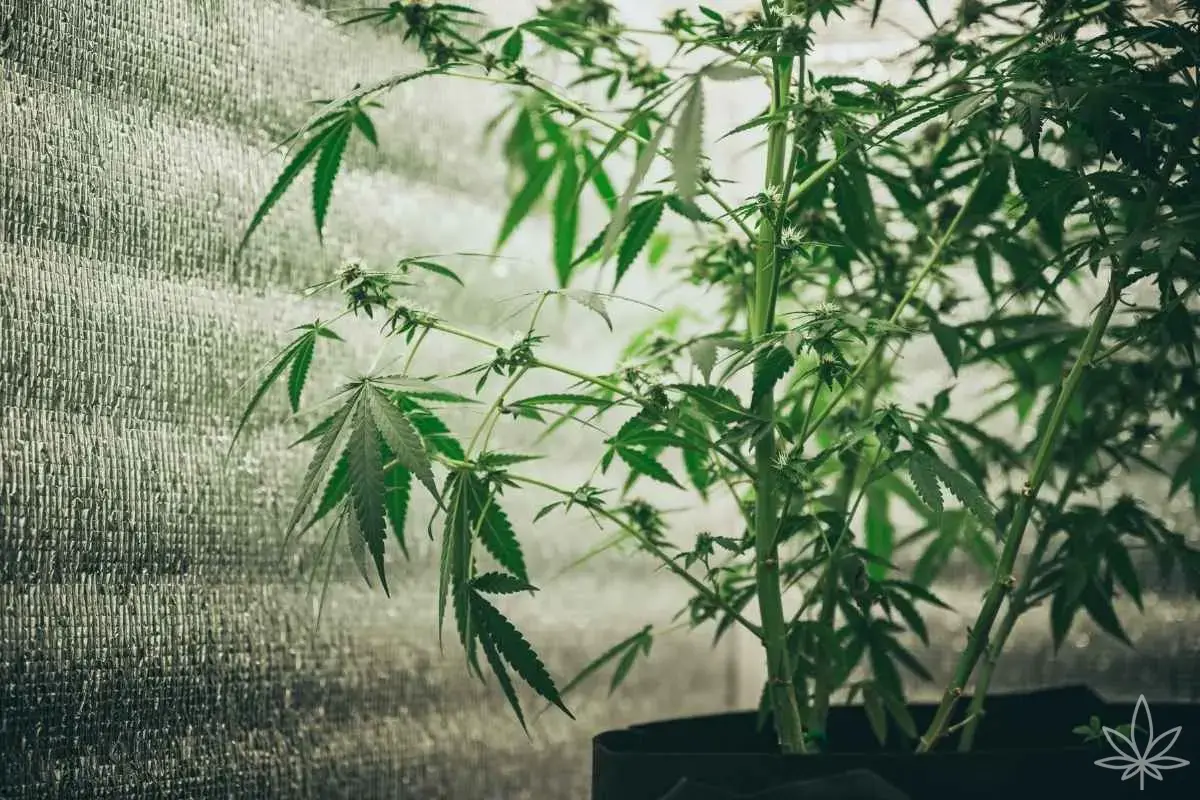
Mylar / reflective foil can reflect up to 95–97% of light. Sounds like the holy grail, right? But there’s a catch.
Pros:
- very high reflectivity,
- excellent for grow tents,
- can noticeably increase light in lower canopy zones.
Cons:
- hotspots are common if the foil is wrinkled,
- reflection is directional rather than diffuse,
- harder to install and keep clean.
Poorly installed Mylar can:
- scorch leaves locally,
- distort PPFD readings,
- increase light stress, especially under powerful LEDs.
👉 Grower’s takeaway:
Mylar is great in tents and small, well-controlled spaces. In DIY grow rooms, white paint often wins through stability and predictability.
Aluminum Foil – a Classic Beginner’s Mistake
This one needs to be said clearly.
Regular kitchen aluminum foil:
- reflects light unevenly,
- creates sharp, focused reflections,
- easily produces hotspots.
The result?
- localized leaf burn,
- no real yield gain,
- often more harm than benefit.
If you see a grow room wrapped in silver foil like a kebab – that’s not optimization, it’s improvisation.
👉 Not recommended. Even cheap white paint does a better job.
Colors Other Than White – Do They Make Sense?
Short and honest:
- Black – absorbs light → wasted energy
- Gray – lower reflectivity than white
- Green – the “plants can’t see green” myth; pointless indoors
- Purple / blue “grow colors” – zero real benefit
The plant doesn’t care about wall color itself, only about how much usable light reaches the leaves.
👉 The only color that consistently makes sense: white.
Does It Really Affect Yield?
Yes – but let’s be realistic.
Changing wall color:
- won’t replace a good lamp,
- won’t fix bad VPD,
- won’t correct poor nutrition.
But in a well-dialed grow:
- it improves light utilization,
- increases uniformity of growth,
- can deliver 5–15% more dry yield,
- improves lower bud quality (less popcorn).
Those are numbers many growers can actually feel in practice.
The maryjane.farm Verdict
This is not a myth, but it’s also not a magic trick.
If I had to sum it up like an experienced grower talking to a newer one:
First dial in your light, climate, and root zone.
Then paint the walls white.
Only after that start playing with foils and fine tuning.
Matte white paint remains the gold standard of indoor growing. Simple, cheap, and effective.
Everything else is a tool – useful in the right hands, but not mandatory.