If I had to point to one thing that makes beginners (and sometimes even experienced growers) lose the most yield indoors, it wouldn’t be strain choice, and it wouldn’t even be the light. It would be pH. Because pH is like an invisible switch: you can have the best nutrients, a perfect EC (Electrical Conductivity — the conductivity of the solution, which indirectly means the “strength” of the feed), and the plant will still look like it’s starving. And that’s when the classic spiral begins: increasing doses, adding more supplements, playing with Cal-Mag… while the problem isn’t “too little” — it’s “it can’t uptake it.”
The worst part is that pH on the internet is often treated like religion: “keep 6.5 and you’ll be fine.” But that advice works like “eat 2000 calories a day and you’ll lose weight.” It might work for someone, but for many people it will derail the grow, because the medium, the water, the microbiology, and the feeding style all matter.
In this article we disarm the myth of the “perfect pH” and build an approach that gives stable plants and yield — without nervous corrections every two days.
First: What Is pH and Why Do Plants Care?
pH is a measure of how acidic or alkaline a solution is. The scale runs from 0 to 14, where 7 is neutral. In indoor growing, pH matters because it affects whether the plant can uptake specific nutrients.
It doesn’t work like nutrients “disappear” at the wrong pH. They are still in the medium or in the feed solution, but the plant cannot absorb them effectively. This is what growers commonly call lockout, meaning nutrient uptake blockage.
That’s why pH is so deceptive: the symptoms look like deficiencies, but adding more fertilizer often makes things worse.
The “Perfect 6.5” Myth — Where It Came From and Why It Hurts
In classic soil cultivation, people often talk about pH around 6.2–6.8. And that isn’t nonsense. The problem starts when someone takes one number from that and turns it into a dogma: 6.5, fixed, always, everywhere.
But indoor growing isn’t one world. There are three most common media, and each behaves differently:
- Soil — a buffered medium with microbiology that also influences nutrient availability.
- Coco coir — a hydroponic-style medium by nature, where pH and calcium/magnesium availability behave differently than in soil.
- Hydro (DWC, NFT, and others) — water as the environment, the fastest plant reactions and the fastest penalties for mistakes.
One pH value will not be optimal for everything. Even worse, holding pH “perfectly” fixed can be worse than slight swings, because the plant uptakes different elements more efficiently at different ranges.
pH in Soil: Why Stability Matters More Than Pharmacy-Level Precision
In soil, pH behaves a bit like a large ship — it changes course slowly. Soil has its own buffering capacity, and microorganisms do their job. That’s why in soil the best results usually come from a calm approach: you don’t hunt one number, you keep a reasonable range and avoid violent corrections.
In practice, many soil grows work well when the water/feed goes in around 6.2–6.8, but the key is something else: not jumping from 5.8 one day to 7.2 the next and back again. That kind of “jerking” destroys balance in the root zone.
If someone obsessively holds 6.5 in soil while using water with high alkalinity (meaning it tends to push pH upward), they can end up chasing their tail: the input is 6.5, but inside the pot the system still drifts alkaline. The result? Micronutrients become less available, the plant pales, and the grower blames the nutrients.
pH in Coco: Here, “6.5” Can Be a Request for Trouble
Coco is a medium many people treat like soil — and that’s a mistake. Coco is closer to hydroponics than to soil. Reactions are faster, and nutrient availability — especially calcium (Ca) and magnesium (Mg) — is very sensitive to pH and feeding style.
In coco, running pH too high (around 6.5) often ends with the plant showing “deficiency” symptoms (especially magnesium and micros), even though you are feeding. On the other hand, pH too low can also cut off certain nutrients.
That’s why in coco it’s better to think in ranges, not one number. Many growers keep roughly ~5.8–6.2 as a working zone, because it gives good macro and micro availability and matches typical “coco” nutrient programs.
Hydro: The Fastest Results and the Fastest Punishment
In hydro, pH has a life of its own. The plant uptakes ions, the solution composition changes, and pH can drift. And to a certain extent, that is normal.
In systems like DWC (Deep Water Culture — growing in aerated nutrient water) or NFT (Nutrient Film Technique — a thin film of nutrient solution flowing over roots), people often panic when pH shifts by 0.2–0.4 within a day. And that doesn’t have to mean trouble. Trouble starts when pH runs to extremes or when the swings are accompanied by stress symptoms.
In hydro, most growers usually keep roughly 5.5–6.1, but the key is the same as above: stability and avoiding nervous, aggressive corrections.
pH Swings — When They’re Normal and When They’re a Red Flag
This is the point where many people make the mistake of “control for the sake of control.” pH swings can be normal, because the plant uptaking different nutrients changes the balance of the solution.
Normal swings in practice:
- in hydro: small daily swings if the plant is growing hard,
- in coco: small differences between what you pour in and what comes out as runoff (runoff is the solution that drains out of the pot after watering),
- in soil: relative stability, but without obsession over a single number.
Red-flag swings:
- pH repeatedly runs into extremes (for example dropping below 5.3 or rising above 6.8 in systems without strong buffering),
- the plant shows stress symptoms despite “good” feeding,
- repeat “deficiencies” appear at the top that cannot be reasonably fixed with dosage.
The Most Common Mistake Scenario: Lockout Symptoms and “Panic Feeding”
From a grower’s perspective it looks like this: leaves lighten, tips burn, growth slows. A warning light goes on: “I’m missing nitrogen, magnesium, something.” You add nutrients. It gets worse. You add Cal-Mag. It gets even worse. Suddenly you have a plant that looks both hungry and overfed.
That’s classic lockout. The plant has a “full fridge,” but the door is locked by pH (or by EC swings, root temperature, or terrible VPD). And that’s why the real skill is not “more nutrients,” but restoring conditions where the plant can uptake again.
How to Measure pH Sensibly (So You Don’t Go Crazy)
Here I’ll use one short list, because it’s genuinely worth organizing.
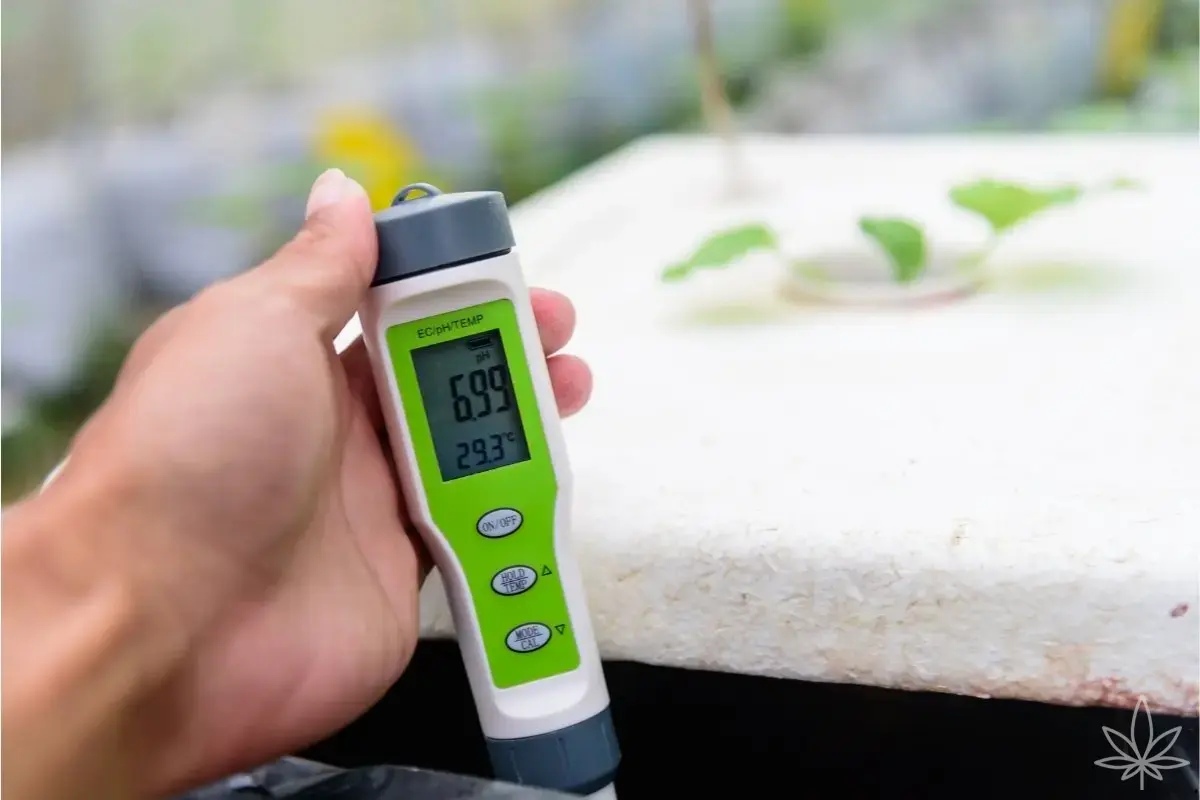
The most common reasons people “have good pH” and still have problems are measurement errors:
- a cheap, out-of-calibration meter,
- no calibration using buffer solutions,
- measuring in a dirty cup,
- measuring right after adding nutrients without waiting for the solution to stabilize,
- not checking runoff pH in coco (runoff is the solution that drains out of the pot after watering).
If you want the minimum measurement hygiene: calibrate your meter regularly, store the electrode in the proper storage solution, and don’t treat it like a soup spoon.
What to Do If You Suspect pH Lockout
I won’t write a “step-by-step” service manual here, but I will give you grower logic.
If the plant looks like it has deficiencies despite feeding, and pH has been held “perfectly” as one fixed number, the first thing you do is stop “chasing the digit” and look at the whole picture: medium, watering frequency, runoff (in coco), EC stability, root temperature, and climate.
Often, returning to a calm, correct pH range for the given medium and holding stability for a few days gives better results than any “magic” additives.
The maryjane.farm Verdict
“Perfect 6.5” isn’t bad by itself. It becomes bad when you treat it like a universal key for everything and hold it rigidly regardless of the medium.
In soil, stability and a healthy root zone matter most.
In coco, pH that’s too high can create symptoms that look like deficiencies but aren’t.
In hydro, swings are part of the game, and the problem starts only when you run into extremes or start fighting pH nervously every few hours.
pH isn’t sexy, it doesn’t look like a new light in a box, but it’s one of those topics that makes the difference between “something grew” and “I’m running a stable, repeatable yield.”